What Type of Art Did Vincent Van Gogh Specialise in
Andrea Promise, 2018
The next in my 2018 European vacation series – xv July
Similar the French Soccer team playing in the World Loving cup, I am on a mission today. I am looking for Yellowish house in Arles, Provence, or at to the lowest degree where it used to stand up before information technology was bombed by the Allies (accidentally) in May 1945.
It is the house that Vincent Van Gogh rented and painted in 1888, hoping to first an creative person commune in Arles. Paul Gauguin visited for a short time, but this proved to be an unhappy experience for both of them.

He rented four rooms at ii Place Lamartine, on the right wing of the nearest building in the painting. The 2 ground floor rooms were used for a studio and a kitchen. The upstairs corner room was the invitee room for Gauguin, while the one next to it (with ane shutter closed) was Van Gogh's bedroom – the 1 later painted with the chair and pipe. At a later signal, he rented two more rooms upstairs at the back of the house.
On 16 September 1888 Vincent wrote to his sister Wilhelmina describing the house, and his contentment at finding a place where he felt he could think and paint:
"… Also a sketch of a 30 foursquare canvas representing the house and its setting under a sulphur sunday under a pure cobalt sky. The theme is a difficult one! Just that is exactly why I want to conquer it. Because it is fantastic, these xanthous houses in the sun and also the incomparable freshness of the blue. All the ground is xanthous too. I will soon send you a ameliorate drawing of it than this sketch out of my head.
The house on the left is pink with dark-green shutters. Information technology's the ane that is shaded by a tree. This is the eating house where I become to dine every day. My friend the factor is at the cease of the street on the left, between the two bridges of the railroad. The night café that I painted is not in the picture, it is on the left of the restaurant."
– Alphabetic character to Theo (543) dated 28 September 1888
I left the cruise gunkhole and prepare off for the sometime department of town – the very helpful Cruise Director had marked the spot that she thought it had been on the map. Even so when I found the fiddling square I couldn't find any plaque or reference to the house, then I asked a local tour guide who merely laughed and said 'simply it doesn't be any more!' and turned back to her tour participants.
So then with my less than trusty map, I set off to find signs of the house. I firstly came across a cafe which he painted (where I paid a ridiculous corporeality for a soft potable).
I then constitute a small garden where Van Gogh painted (also now heavily commercialised ) next to the hospital where he had been admitted in Arles.
Then to the local museum which houses several of his works.

Included in the photos beneath are some close ups of the canvass so you can see how he practical the paint..

Vincent Van Gogh, portrait of a immature peasant, 1889

Vincent Van Gogh, peasant woman bounden sheaves(afterward Millet) 1889

Vincent Van Gogh, the sheepshearers (after Miller), 1889


Vincent van Gogh, Railway carriages, Arles, 1888

Vincent Van Gogh, harvest in Provence, 1888

Vincent Van Gogh, Skull, 1887
After leaving the museum and heading back towards the boat, I found the information centre where another very helpful person produced a new map, and placed a new X – which was about 50 metres from where the gunkhole was moored! I had walked close by when I'd set out on my search nearly two hours beforehand.


I besides realised that one of his starry nighttime paintings would probable accept been done in the vicinity of the boat mooring.

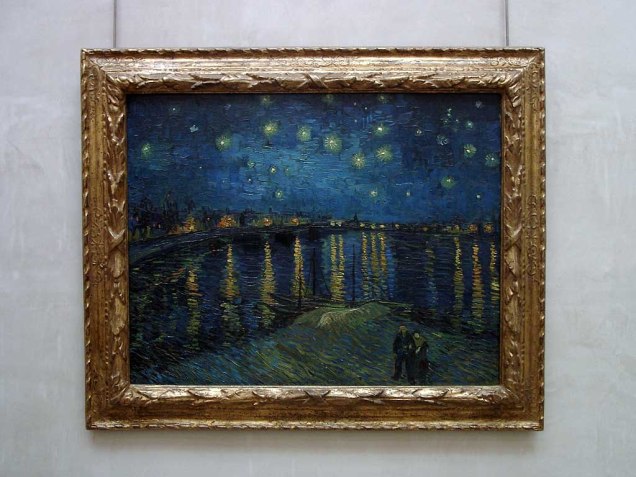
Vincent Van Gogh, Starry Night over the Rhone River
(On road to our run a risk later in the afternoon – we also saw the sunflowers where Vincent would take painted, the infirmary at St Remy where he stayed, and the monastery where he painted.)

So, like the French soccer players, mission accomplised, and a great reason to gloat!
And merely to finish, a few pics of the expanse.
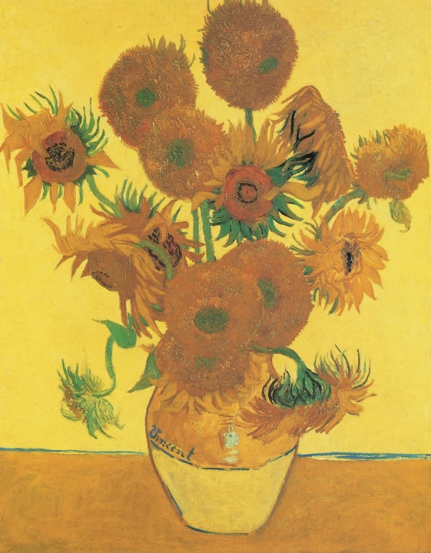
Dutch artist Vincent van Gogh's first job was working in the Hague branch of an international art dealing firm, Goupil & Cie. It was 1869 and he was just sixteen.
He was reasonably successful in the firm so he was then was transferred to the London branch in 1873 and then later to Paris. However, he lost interest in the role, which led to his dismissal in 1876.
Following this, he briefly became a teacher in England, and then, deeply interested in Christianity (his father was a Protestant Government minister), a lay preacher in a mining community in southern Belgium. He was as well dismissed by the church, but his future artwork was heavily influenced past his spiritual beliefs.

Interior of fine art dealer Goupil & Cie in The Hague, c1900

The Studio of Fernand Cormon c 1885
Largely cocky-taught, van Gogh began his study as an artist by meticulously copying prints and studying nineteenth-century cartoon manuals and lesson books. He believed that it was necessary to primary working with black and white earlier working with color, and that it was important to concentrate on learning the rudiments of figure cartoon and rendering landscapes in correct perspective.
Van Gogh'south admiration for the Realist Barbizon artists, in particular Jean-François Millet, whose work he'd seen in London, influenced his decision to paint rural life. During 1884 – 85, while again living with his parents in Nuenen in the Netherlands, he painted more than forty studies of peasant heads, which culminated in The Irish potato Eaters. Van Gogh wrote that he wanted to express that they "have tilled the earth themselves with the same hands they are putting in the dish".

Vincent Van Gogh, Head of a Homo, 1884-85

Vincent Van Gogh, Woman Lifting Potatoes, 1885

Vincent Van Gogh, Woman with a Mourning Shawl, 1885

Van Gogh, Worn Out, 1882

Vincent Van Gogh, The White potato Eaters, 1885

Jean Francois Millet, The Young Seamstress
His fashion underwent a major transformation during a two-twelvemonth stay in Paris from 1886 to 1888. During this period he took lessons in the studio of Fernand Cormon – an artist who was very pop with foreign students. Information technology was here that he met fellow students Henri de Toulouse-Lautrec and Emile Bernard. Vincent'due south brother Theo was by this time the manager of Goupil and Cie in Paris, and he was able to introduce Vincent to the light filled work of prominent Impressionist artists such equally Claude Monet and Camille Pissarro. Vincent also saw the latest technical innovations (pointillism) past Mail Impressionists Georges Seurat and Paul Signac.
Vincent discovered a new source of inspiration in Japanese woodcuts, which sold in big quantities in Paris. Both he and Theo began to collect them. The influence of the bold outlines, cropping and colour contrasts in these prints showed through immediately in his ain work.
He used brighter colours and developed his own style of painting using short castor strokes. The themes he painted also changed, with rural labourers giving mode to cafés and boulevards, the countryside along the Seine and floral withal lifes. He also tried out more commercial subjects, such as portraits. However, Vincent mostly acted as his own sitter, as models were relatively expensive, and he painted more than 20 cocky-portraits.

Hiroshige, Sudden Shower Over Shin-Ohashi Bridge and Atake, 1857

Van Gogh, The Blooming Plumtree (afterward Hiroshige), 1887

Van Gogh, Paul Gauguin's Armchair, 1888

Van Gogh, Roses and Sunflowers, 1886


By 1888 Vincent began to tire of the frenetic city life in Paris. Unfortunately his mental health began its decline, resulting in tearing mood swings, depression, and drunken and erratic behaviour. He longed for the peace of the countryside, for sun, and for the calorie-free of 'Japanese' landscapes, which he hoped to find in Provence in the South of France, so in Feb 1888 he moved to the "little yellow business firm" in Arles.
He hoped his friends would join him and help found a colony of artists. Paul Gauguin did join him for a short menses of time, simply with disastrous results. Van Gogh'southward nervous temperament fabricated him a difficult companion and night-long discussions combined with painting all twenty-four hour period undermined his health. It was at this fourth dimension that he cutting off part of his left ear with a razor. Penniless, he spent his coin on pigment rather than food, living on coffee, bread and absinthe.
His ongoing depression caused him to seek periodic refuge in a nearby asylum at St Remy. Over the course of the next year, he painted some 150 paintings, including many nonetheless lifes and landscapes. He besides painted copies of works, using black-and-white photographs and prints, by such artists as Delacroix, Rembrandt and Millet. He described his copies every bit "interpretations" or "translations", comparing his role as an artist to that of a musician playing music written by another composer.
In May of 1890, his mental health appeared to have improved and he moved to Auvers-sur-Oise under the watchful center of Dr. Gachet. 2 months later he was expressionless, having reportedly shot himself "for the skillful of all".
Van Gogh's finest works were produced in less than three years – in a technique that grew more and more impassioned in brushstroke, in symbolic and intense color, in surface tension, and in the movement and vibration of form and line.
During his cursory career he sold only one of his paintings. However, past 1890, van Gogh'due south work had begun to attract critical attention. His paintings were featured at the Salon des Indépendants in Paris between 1888 and 1890, likewise equally in Brussels in 1890, and manufactures almost his work began to appear in major newspapers.

Van Gogh, Two Peasant Women Digging in a Snow-Covered Field at Dusk, 1890

Van Gogh, Self Portrait in a Straw Chapeau, 1887

Van Gogh, The Starry Night, June 1889

Van Gogh, The Dark Café, 1888

Van Gogh, The Café Terrace on the Place du Forum, Arles, at Nighttime, 1888
Read more, and see a full range of images at the Van Gogh museum in Amsterdam https://world wide web.vangoghmuseum.nl/en.
This blog is just a short excerpt from my fine art history e-grade, Introduction to Modern European Art which is designed for adult learners and students of fine art history.
This interactive program covers the period from Romanticism right through to Abstract Art, with sections on the Bauhaus and School of Paris, key Paris exhibitions, both favourite and less well known artists and their work, and information about colour theory and primal fine art terms. Lots of interesting stories, videos and opportunities to undertake exercises throughout the program.
If y'all'd like to meet some of the Australian artwork you'll find in my gallery, scroll downwardly to the bottom of the page. You'll too observe many French works on paper and beautiful fashion plates from the early on 1900s by visiting the gallery.



By the last Impressionist exhibition in 1886, a number of artists were seeking a shift in focus. Key amongst these were Paul Cezanne, Georges Seurat Vincent Van Gogh and Paul Gaugin.
Some felt that the Impressionists had allowed their preoccupations with technique and the effects of natural light to overshadow the importance of subject matter. (You tin encounter examples of Impressionist works beneath and read more well-nigh Impressionist artists in earlier blogs.)

Eva Gonzalés, The Woman in Pinkish, c1865

Berthe Morisot, Rosbras, Brittany, 1866-67

These artists developed independent styles for expressing emotions rather than but painting optical impressions, concentrating on themes of deeper symbolism.
Through the use of simplified colours and definitive forms, their art was as well characterised by a tendency towards abstraction – that is, not painting their subjects as they actually appeared. However, in doing so, they too created a sense of intrigue virtually the artist was trying to portray.

Eventually these dissenting artists became known as the Postal service-Impressionists, a term coined by British art critic Roger Fry in 1910 post-obit an exhibition in London. Other artists recognised equally mail-impressionists include:
-
Henri Rousseau 1812-1867
-
Paul Signac 1863 – 1935
-
Emile Bernard 1868 -1941
- Susan Valadon 1865 – 1938
At that place is no style or manifesto of aims common to the artists but more often than not Post-Impressionists continued to employ the vivid colours, thick application of paint and real-life subject area matter favoured by the Impressionists, simply were more than inclined to emphasise geometric forms, to distort form for expressive effect, and to use unnatural colours.
You can encounter, for case, the mode in which Paul Gauguin painted large areas of flat colours, whereas Georges Seurat introduced a method of 'scientific' painting using pocket-size dots known as Divisionalism. Cezanne played with moving picture planes and geometry and Van Gogh used strong color to evoke emotion. It was period of nifty exploration that encouraged the idea that at that place was no limit to experimentation in the fashion in which artworks could exist painted.
Post-impression provided a vital and creative link betwixt the Impressionist revolution and the founding of all the subsequent major fine art movements of the 20th century, which I will be exploring farther.
In my side by side mail I will talk about one of my favourite artists – Paul Cezanne
Ane of the most influential artists in the history of twentieth century painting, Paul Cézanne inspired generations of modernistic artists. Generally categorised as a Post-Impressionist, his unique method of building course with colour, and his analytical approach to nature influenced the fine art of Cubists, Fauvists, and successive generations of avant-garde artists.
This is an excerpt from my interactive online modern art appreciation program http://world wide web.modernartappreciation.com where yous will be able to run across the full context for Post-Impressionism in Mod Art, and contribute through exercises and discussion.
Source: https://kiamaartgallery.wordpress.com/tag/vincent-van-gogh/
0 Response to "What Type of Art Did Vincent Van Gogh Specialise in"
Post a Comment