The Bible Says I Did Not Know You
| Matthew 7:23 | |
|---|---|
| ← 7:22 vii:24 → | |
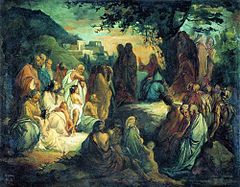 "The Sermon on the Mountain" past Nikolay Lomtev (1816–1858), earlier 1858. | |
| Book | Gospel of Matthew |
| Christian Bible part | New Testament |
Matthew 7:23 is the twenty-tertiary verse of the seventh chapter of the Gospel of Matthew in the New Testament and is part of the Sermon on the Mount. This verse continues Jesus' warning against imitation prophets. We must rely of Christ as a replacement for our works In order to be counted as a worker worthy of sky, any works done presented to God washed by one'southward self is non pure. This volition happen to anyone who doesn't count Christ as their ransom before God and obtain mercy and spotless coverage though the Passover lamb of God, volition exist treated as a trespasser of the law and an unclean (unrighteous) person.
Content [edit]
In the Male monarch James Version of the Bible the text reads:
- And then will I profess unto them, I never
- knew you lot: depart from me, ye that work iniquity.
The Globe English Bible translates the passage as:
- Then I volition tell them, 'I never knew
- you. Depart from me, you who work iniquity.'
The Novum Testamentum Graece text is:
- καὶ τότε ὁμολογήσω αὐτοῖς ὅτι Οὐδέποτε ἔγνων ὑμᾶς
- ἀποχωρεῖτε ἀπ' ἐμοῦ οἱ ἐργαζόμενοι τὴν ἀνομίαν.
For a drove of other versions run across BibleHub Matthew seven:23
Analysis [edit]
The previous verse featured charismatic miracle workers appealing to Jesus at the Final Judgment after being condemned even after performing miraculous acts. This verse is Jesus' response.
This poesy gives testify for what the author of Matthew believed Jesus' role would exist at the Last Judgment, an important Christological question. Hare believes that the wording makes clear that Jesus is not the judge, but is rather a witness or advocate before God. Jesus does non use the language of a judge. The word translated as profess/tell is a specific legal term that was used by a witness in a court of police force while making a argument.[1] French republic and Schweizer disagree, and believe that in these verses Jesus is presenting himself as the judge at the Last Judgment.[2] [3]
The concluding part of the poetry is a reference to Psalm 6:eight.[4] It is likewise rooted in Jewish legal traditions. "Depart from me" is a phrase of renunciation to exist used confronting those who accept been expelled from the community. "You hateful nothing to me" was an equivalent, if stronger, possible phrase.[5] The phrase translated every bit "you who work iniquity," literally means "you who break the law." Alternative translations are evildoers or lawbreakers. At that place is debate among scholars over whether this is a specific reference to the Law of Moses. Christian churches have long rejected the need to follow the Mosaic codes, only some scholars believe that the author of Matthew did believe that they needed to be obeyed.
[edit]
Pseudo-Chrysostom: For bang-up wrath ought to be preceded by cracking forbearance, that the sentence of God may be made more than just, and the death of the sinners more merited. God does not know sinners considering they are not worthy that they should be known of God; not that He birthday is ignorant apropos them, but because He knows them not for His own. For God knows all men according to nature, only He seems not to know them for that He loves them non, equally they seem not to know God who exercise non serve Him worthily.
Chrysostom: He says to them, I never knew yous, every bit it were, not at the day of judgment but, merely not fifty-fifty and then when ye were working miracles. For there are many whom He has at present in abhorrence, and yet turns abroad His wrath earlier their punishment.
Jerome: Note that He says, I never knew you, as beingness against some that say that all men have e'er been among rational creatures.a
Gregory the Great: By this sentence it is given to us to larn, that among men charity and humility, and not mighty works, are to be esteemed. Whence also now the Holy Church, if there exist any miracles of heretics, despises them, because she knows that they take not the marker of holiness. And the proof of holiness is not to work miracles, but to love our neighbour equally ourselves, to think truly of God, and of our neighbor better than of ourselves.
Augustine: Simply never let it exist said as the Manichees say, that the Lord spoke these things concerning the holy Prophets; He spoke of those who after the preaching of His Gospel seem to themselves to speak in His name not knowing what they speak.
Hilary of Poitiers: Simply thus the hypocrites boasted, as though they spoke somewhat of themselves, and as though the ability of God did not work all these things, being invoked; only reading has brought them the knowledge of His doctrine, and the name of Christ casts out the dæmons. Out of our own selves so is that blessed eternity to be earned, and out of ourselves must be put forth something that we may volition that which is good, that we may avoid all evil, and may rather do what He would have us do, than boast of that to which He enables the states. These then He disowns and banishes for their evil works, saying, Depart from me, ye that work iniquity.
Jerome: He says non, Who have worked, merely, who work iniquity, that He should non seem to take away repentance. Ye, that is, who up to the present hour when the judgment is come, though ye have not the opportunity, yet retain the desire of sinning.
Pseudo-Chrysostom: For death separates the soul from the torso, but changes not the purpose of the centre.
References [edit]
- ^ Hare, Douglas R. A. Matthew. Interpretation, a Bible commentary for education and preaching. Westminster John Knox Press, 1993
- ^ France, R.T. The Gospel Co-ordinate to Matthew: an Introduction and Commentary. Leicester: Inter-Varsity, 1985. pg. 149
- ^ Schweizer, Eduard. The Good News According to Matthew. Atlanta: John Knox Press, 1975 pg. 188
- ^ Hill, David. The Gospel of Matthew. M Rapids: Eerdmans, 1981 pg. 152
- ^ Hare, Douglas R. A. Matthew. Estimation, a Bible commentary for pedagogy and preaching. Westminster John Knox Press, 1993
The Bible Says I Did Not Know You
Source: https://en.wikipedia.org/wiki/Matthew_7:23
0 Response to "The Bible Says I Did Not Know You"
Post a Comment