How Do You Read a Winds Aloft Forecast

Privacy Policy Weather condition of Use
Forecast Winds and Temps Aloft
 Forecast Winds and Temperatures Aloft is a forecast of current of air management and speeds and of temperatures at different altitudes for specific locations. Data for the forecasts are gathered using a small expendable radiosonde attached to a 2 meter hydrogen or helium balloon. These balloons are released twice daily. Boosted information is collected past commercial shipping (AMDAR/MDCRS/ACARS), and a network of current of air profiling radars operated by NOAA Global Systems Partitioning (formerly known as Forecast Systems Laboratory).
National Centers for Ecology Prediction (NCEP) produces scheduled wind and temperature aloft forecasts four times daily for the Continental United States, the Hawaiian Islands, Alaska and coastal waters, and the Pacific Bounding main based on data nerveless past the atmospheric condition balloon. There is no requirement to event amendments to these forecasts. These reports were known equally "FD" in the US, but are becoming known every bit "FB", following the Globe Meteorological Arrangement (WMO) nomenclature.
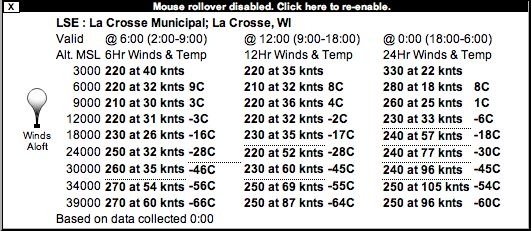
For each report, three time periods are forecasted. These are known equally 6-60 minutes, 12-hr, and 24-hour forecasts. For each forecast menses, there are ii time designations:
- Valid time: the specific time for which the winds and temperatures are forecast; and the
- For Employ time: the time range for which the forecast values may be used.
In the higher up figure, the Valid time is this commencement time after the "@", and the For Use time range is given in the parentheses. The time of the data collection (by the weather balloons) is given at the bottom of the effigy.
Altitudes are true altitude in anxiety MSL up to 12,000'. Altitudes 18,000 and higher are pressure level altitudes. Winds are not forecasted within 1,500' of station superlative. Temperatures are not forecasted within 2,500' of station peak. Hawaii and Pacific Ocean forecasts include lower elevation forecasts.
Rules of Thumb
Winds and Temperature Aloft forecasts aids pilots with flight planning in that they forecast the existence (or absence) of head winds or cross winds which might dramatically change flying times and fuel consumption. Temperatures aloft can evidence temperature inversions, or unusually warm layers where climbing functioning may exist affected.
Winds differ more than 18knts
Jack Williams, coordinator of public outreach for the American Meterological Society and frequent contributer to AOPA's Flight Training mag wrote in the December 2007 issue that someday the departure between two reporting altitudes is more than 18 knots, "current of air shear could brand a flying between those altitudes bumpy." As an help, AvnWx.com places a dotted line betwixt such altitudes under the wind data particular, in the Winds Aloft display. You can see some examples in the higher up figure, such every bit between 30000 and 34000 in the 6hr report. Information technology's more than just a simple 18knt difference, of course -- one has to consider the change in air current direction too. For example: 210 at 23 knts changing to 160 at 22 knts isn't a 1 knt wind shift, it is a xix knt wind shift!
Notation that wind shear can happen anywhere so don't be conceited just because at that place isn't a dotted line at your altitude on this website.
Temperature more than 3° per 1000'
Aviation Weather (page 52) gives some guidance regarding atmospheric stability, which can be estimated by observing how the temperature decreases with altitude:
- When temperatures decrease uniformly and rapidly every bit altitude increases (approaching 3°C per 1000'), you have an indication of unstable air.
- If the temperature remains unchanged or decreases on slightly with altitude, the air tends to be stable.
- If the temperature increases with distance through a layer -- an inversion -- the layer is stable and convection is suppressed. Air may be unstable below the inversion.
- When air near the surface is warm and moist, suspect instability. Surface heating, cooling aloft, converging or upslope winds, or an invading mass of colder air may lead to instability and cumuliform clouds.
Instability is shown in the effigy as a dotted line betwixt altitudes nether the temperature data detail, when the temperature decreases more than three°C per 1000'. Encounter the line, for instance, between 24000 and 30000 in the 6hr written report.
Note that these are merely a forecast and local wind management and speed tin vary widely. When getting a Weather Brief, y'all may get more current data, but also as your briefer for PIREPs which may be direct relevant for your flying path.
AvnWx.com currently provides Winds and Temperatures Aloft data as obtained from Aviation Atmospheric condition Eye NWS Textual FB Winds/Temps Aloft product, covering only Continental US and Alaska. Hawaii and Pacific Body of water data is under development.
Information on this page is derived from NWSI 10-812, Air conditioning 00-45E, and NOAA'southward Aviation Weather Center website. For further information, see:
- NOAA's National Weather Service, NOAA Profiler Network website
- NOAA'due south National Atmospheric condition Service, Aviation Weather Center, Forecast Winds and Temps Aloft Assistance website.
- NOAA'due south Earth Arrangement Research Laboratory, Global Systems Partition (GSD) website
- Aviation Wind and Temperature Aloft Forecasts, National Weather Service Instruction (NWSI) 10-812 (September 14, 2004).
- FAA's Aviation Weather Services : Ac 00-45E

More information is available on the map's Forms and Controls, on the map's icons, and on the data sources.
Suggestions? Questions? Corrections? Allow us know! E-mail
How Do You Read a Winds Aloft Forecast
Source: https://maps.avnwx.com/help/winds.html
0 Response to "How Do You Read a Winds Aloft Forecast"
Post a Comment